


Getting HOA Approval for Window Upgrades Without the Runaround
Getting HOA approval for window upgrades should be a paperwork task, not a second job. Yet a missing color sample, an unclear drawing or a verbal “looks fine” can turn a straightforward replacement into weeks of back-and-forth.
The best way to reduce that runaround is to submit a package the architectural review committee can actually evaluate, then keep the decision attached to the exact products you intend to install. That means separating neighborhood appearance rules from building requirements, documenting your choices and resisting the temptation to order first and explain later. Custom windows make expensive conversation starters when they cannot be installed.
Start With the Rules That Apply to Your Property
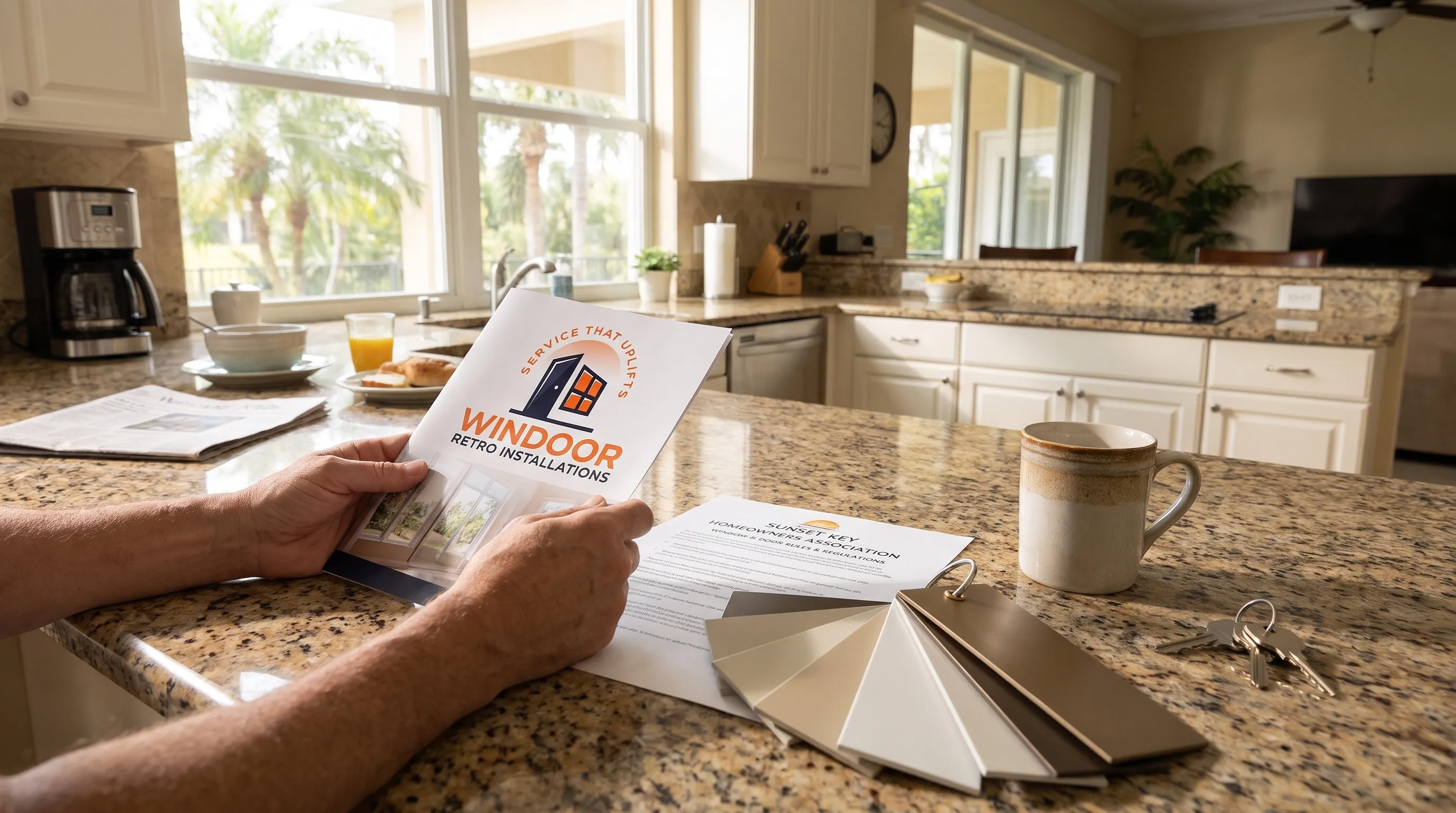
Before choosing a window, request the current declaration, architectural guidelines, application form and any separate hurricane-protection specifications. Ask the management company which documents control your project and whether the committee reviews applications continuously or at scheduled meetings.
Find out whether your property belongs to a homeowners association governed by Florida’s Chapter 720 or a condominium association governed by Chapter 718. They are not interchangeable. In a condominium, ownership boundaries and maintenance responsibilities can affect whether an owner may replace a window independently.
For window upgrades, get the appearance requirements before spending time pricing a product the association will not accept. Look for exterior frame color, grid patterns, operating style, reflective glass restrictions and requirements for matching adjacent units.
Also ask what makes an application complete, how decisions are delivered and whether approval expires. If management mentions a deadline, request the document establishing it rather than relying on neighborhood memory.
A neighbor’s recent installation can be a useful reference, but it is not your approval. Their home may have different governing provisions, an older authorization or a violation nobody has addressed yet. None of those possibilities belongs in your project plan.
Understand Florida’s Hurricane-Protection Rules
Florida law matters when the proposed replacement includes hurricane protection. Section 720.3035 of the Florida Statutes addresses architectural control and requires associations governed by that section to adopt hurricane-protection specifications. It also restricts denial of qualifying installations that conform to those specifications.
That is not the same as saying anything sold as an impact window automatically gets approved. Product performance, exterior appearance and the proposed installation still need to be evaluated against the applicable requirements. The statute also addresses consistency with an existing unified building scheme.
If someone tells you the association simply “does not allow impact windows,” ask for the written specifications and the basis for that position. A blanket statement deserves clarification, not an argument at the mailboxes.
For window upgrades involving storm protection, identify the governing statute and the association’s adopted standards before treating a verbal objection as the final answer. Condominium hurricane-protection provisions are different, so condo owners should not rely on an HOA explanation alone.
If the association’s interpretation appears inconsistent with the law, a Florida attorney familiar with community associations can review the documents. A contractor can supply product information; resolving a legal dispute is a different job.
Build One Complete Approval Packet
A committee should not have to guess what your house will look like afterward. Give it a clear comparison between the existing condition and the proposed work.
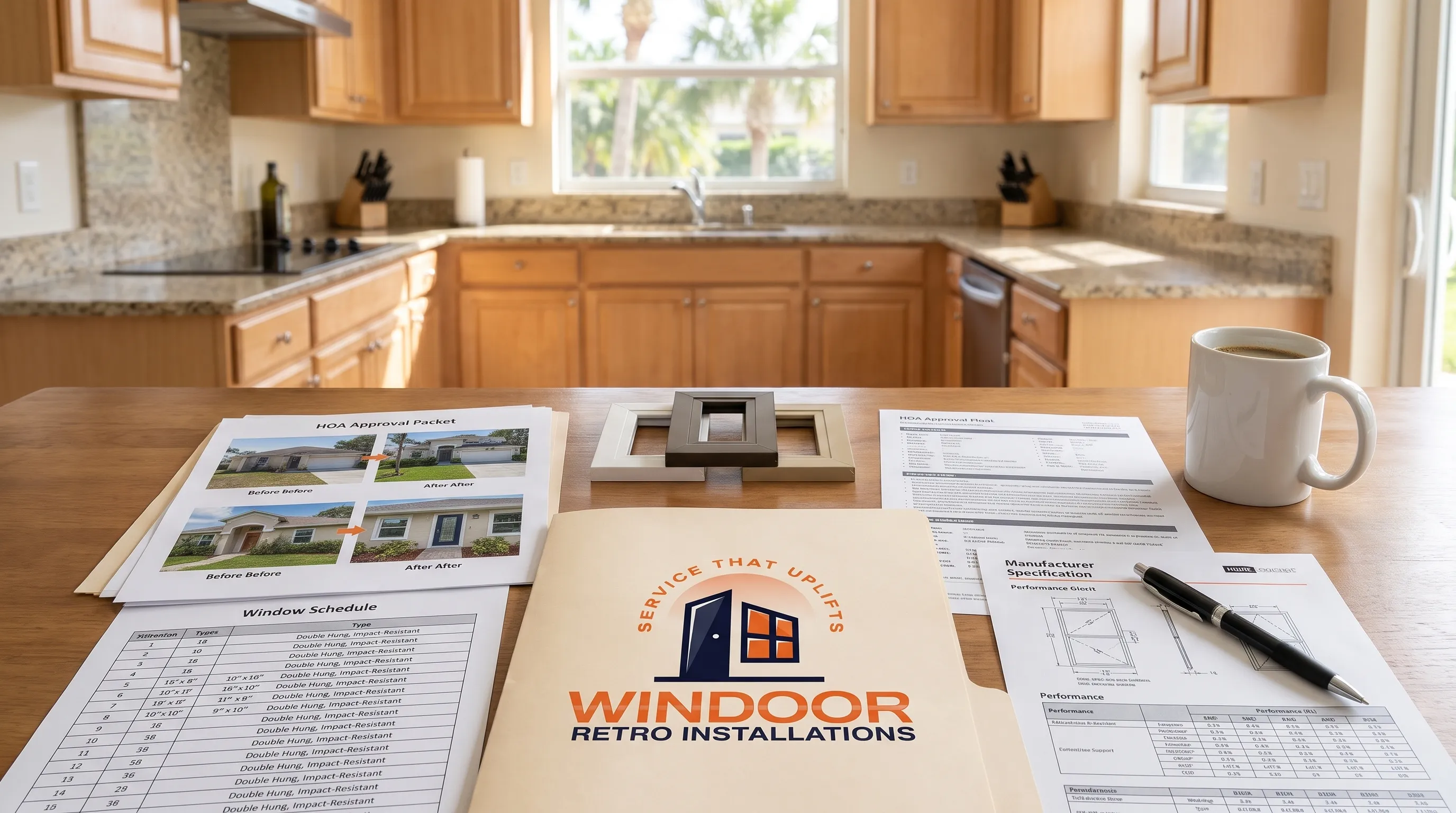
Your submission will typically need the following, subject to the association’s actual application requirements:
- Completed application: Include the property address, owner information and required signatures.
- Existing photographs: Show each affected elevation and close-ups of the current windows.
- Window schedule: Label every opening and identify whether it is being replaced or left alone.
- Product details: Provide the manufacturer, series, operating style and relevant approval documentation.
- Appearance specifications: Identify exterior frame color, grid layout, glass appearance and screen configuration.
- Scope description: State whether opening sizes, trim, stucco or other visible features will change.
- Contractor information: Include licensing and insurance documentation when the application requires it.
For window upgrades, a labeled photograph usually communicates more than a brochure full of options. Mark the affected openings W1, W2 and W3, then use those same labels on the quote and product schedule.
Avoid submitting a brochure showing six colors when you intend to purchase one. Highlight the selected configuration or attach a separate selection sheet. Every unresolved option gives the reviewer another reason to return the package, and sometimes that reason is perfectly legitimate.
Show What Changes From the Street
“White windows” is not a complete exterior specification. Different manufacturers use different shades, frame profiles and visible glass dimensions. A replacement can keep the same opening size yet look noticeably different from the sidewalk.
Compare the proposed frame width, meeting rails, grid pattern and operating style with what is already installed. Replacing two single-hung windows with one picture window changes more than ventilation. It changes the elevation, which is usually what the architectural committee is reviewing.
Glass deserves attention too. Low-emissivity coatings and impact-resistant assemblies can have a different visible tint or reflectivity from the existing glass. Request an appropriate sample or representative product information rather than promising an exact match from a thumbnail image.
When window upgrades need to blend with neighboring homes, submit a straightforward side-by-side description: existing configuration, proposed configuration and any visible differences. State explicitly when there is no opening enlargement or exterior color change.
If an exact match is unavailable because the original product was discontinued, document that fact and propose the closest practical alternative. “They don’t make it anymore” is more useful when supported by manufacturer or supplier information than when passed along as a rumor.
Check Permits and Structural Limits Before Making Promises
HOA approval and building approval are separate. An association’s approval does not replace a permit, and a permit does not automatically satisfy the association’s appearance rules.
Have the contractor verify the applicable requirements with the local building department. Depending on the property and scope, that review can include design pressures, windborne-debris protection, emergency escape and rescue openings, energy requirements and approved installation details.
For window upgrades in Florida, the product documentation must fit the actual opening and installation conditions. A general statement that a window is “Florida approved” does not establish that every size, anchoring method or configuration works everywhere.
Enlarging an opening adds another layer. The project may affect a header, structural supports, utilities, exterior finishes and water management. Have those conditions evaluated before submitting a drawing that promises dimensions the structure cannot reasonably accommodate.
Ask about additional code requirements triggered by the proposed scope rather than relying on an online percentage shortcut. Project-specific answers belong with the contractor and permitting authority.
If permitting changes an approved dimension, configuration or visible finish, determine whether the association needs a revised submission. Catching that conflict before manufacturing is much cheaper than discovering it while an installation crew is standing in the driveway.
Decide Whether Repair, Retrofit or Full Replacement Fits
Not every window problem requires removing the entire assembly. A failed insulated-glass unit may be repairable through compatible glass replacement when the frame and other components remain serviceable. Worn hardware or weatherstripping may also have a targeted solution.
Those repairs will not turn an ordinary window into a tested impact-resistant assembly. Nor will fresh caulk repair a failed seal inside an insulated-glass unit. The diagnosis needs to match the complaint.
Before requesting approval for window upgrades, ask the contractor to distinguish a repair from a retrofit installation and a full-frame replacement. Installation terminology varies, so the written scope matters more than the label.
A retrofit approach may preserve more surrounding finishes when existing conditions allow it. Full-frame work may be appropriate when deterioration, leakage or installation defects require access to the surrounding opening. Neither approach should be promised without evaluating the property.
Explain the selected approach in the HOA package if it affects trim, stucco or visible frame dimensions. Also keep expectations realistic: better glass and a sound installation can improve comfort, but energy savings depend on the existing windows, shading, air leakage and household use. A guaranteed utility-bill payback is not a substitute for a proper assessment.
Submit Once and Preserve the Exact Version
Submit through the association’s required channel, whether that is a portal, email or paper delivery. Keep a copy of everything sent, including attachments and the submission confirmation.
Give the package a date or revision number. If you replace a drawing, label the replacement clearly and identify what changed. Otherwise, the committee may approve one version while the supplier prepares another. Everyone can be acting in good faith and still manufacture the wrong window.
For window upgrades, ask management to confirm receipt and identify any missing items in writing. A delivery confirmation proves that something arrived; it does not necessarily establish that the application was complete.
Read the actual approval before authorizing custom manufacturing. Check the approved product, exterior color, grid pattern, opening sizes and any conditions or expiration date. Compare that decision against the final order, not just the original estimate.
If the approval says “approved subject to matching existing,” resolve what that means before ordering. An ambiguous condition can become a disagreement after installation.
Also check how your contract handles an HOA denial or required product change. Approval-dependent ordering, deposits and cancellation terms should be settled in writing before money is committed to materials that cannot readily be returned.
Follow Up With a Specific Written Request
Repeated phone calls can produce several friendly conversations and no usable answer. Follow up with the submission date, application reference and a short request for the next concrete step.
You can adapt this message:
I submitted the architectural application for [address] on [date], including the photographs, product schedule and exterior finish selections. Please confirm whether the application is complete. If anything is missing, please identify each outstanding item and the applicable requirement. If complete, please confirm the expected review date and how the written decision will be delivered.
For window upgrades, this approach keeps the discussion tied to identifiable documents rather than whether someone remembers speaking with you last Tuesday.
Do not assume every Florida association has the same review deadline. Check the governing documents and applicable law, including how completeness affects any review period. If a stated deadline passes, refer to that provision in your next message.
Most importantly, do not treat silence as permission without confirming that a valid deemed-approval provision applies and that you have satisfied its conditions. Ordering first because nobody replied is a gamble with unusually large packaging.
Respond to a Denial by Narrowing the Issue
If the application is denied, request the written decision and the specific governing provision or specification supporting each objection. Separate appearance concerns from missing documentation, product-performance questions and ownership issues.
A rejection based on bronze frames is different from one based on an incomplete product sheet. The first may require a different selection; the second may require only a better attachment. Resubmitting the entire project without identifying the actual objection wastes another review cycle.
When window upgrades are rejected, propose the smallest revision that resolves the stated concern. Ask whether changing the exterior color, retaining the existing grid pattern or supplying additional glass information would satisfy the requirement.
If the committee demands a discontinued product or an apparently incompatible configuration, provide documentation explaining the problem and request an acceptable alternative. Avoid accusing volunteers of bad faith when a technical misunderstanding may be responsible.
If the denial appears unsupported by the governing documents or conflicts with applicable hurricane-protection law, use the association’s review or appeal process and consider legal advice. Keep the original application, all revisions and correspondence together.
A clean record helps resolve a disagreement. A lengthy email about everyone’s personality generally does not.
Compare Quotes Without Losing the Approved Scope
Two estimates can list the same number of windows and still describe very different projects. Before selecting a contractor, compare what is included and what remains uncertain.
| Quote item | What to clarify |
|---|---|
| Product selection | Exact series, configuration, exterior color and glass package |
| Installation method | What is removed, retained and inspected |
| Permitting | Who applies, pays fees and coordinates inspections |
| Exterior restoration | Responsibility for stucco, trim, sealants and painting |
| Hidden damage | How deterioration is documented, priced and authorized |
| Warranties | Separate product and workmanship coverage, including exclusions |
| Approval changes | What happens if the HOA requires a different selection |
For window upgrades requiring architectural approval, request a final written scope that matches the approved schedule. If the contractor proposes a substitute, determine whether it changes the appearance or performance and whether further review is needed.
Ask how interior protection, debris removal and punch-list items will be handled as well. Those details may not interest the committee, but they will interest the person living in the house.
Our guide to understanding window replacement contracts in Florida covers contract provisions worth checking before signing. A low number on the first page is less useful when half the installation scope is waiting in the exclusions.
Keep Grants, Insurance and Financing on Separate Tracks
HOA approval does not establish grant eligibility, guarantee an insurance discount or approve financing. These processes may involve the same windows, but they answer different questions.
If you are considering the My Safe Florida Home program, check the official program website for current availability, eligibility, inspection requirements and required project sequencing. Do not assume that beginning work or buying materials early will preserve eligibility for reimbursement.
For grant-related window upgrades, compare the program’s requirements with the HOA-approved scope before committing to an order. A change requested by one reviewer may need to be checked with the other. Save inspection reports, product documentation, approvals and final project records.
Likewise, ask your insurer what documentation is necessary to evaluate a wind-mitigation credit. Qualifying improvements and the treatment of other openings can affect the outcome. A contractor should not promise a particular premium reduction on the insurer’s behalf.
If financing is involved, understand payment timing, interest, fees and any approval conditions. PACE financing uses a property assessment rather than an ordinary unsecured payment plan, so review its tax-bill, sale and refinancing implications carefully.
Keep separate written confirmations for each process. One approval letter cannot safely do four different jobs, no matter how official the letterhead looks.
Plan Installation Around Access and Association Conditions
Approval may come with work-hour restrictions, parking instructions, debris rules or requirements for access through common areas. Share those conditions with the contractor before scheduling, not when the truck arrives.
For seasonal residents, designate who can provide access, receive notices and make decisions if concealed damage is discovered. Establish which changes require your written authorization and how photographs or supporting information will be shared.
Scheduling window upgrades while you are away also requires a plan for inspection access, unexpected weather and final acceptance. Our guide to planning window replacement while you are away from Florida addresses those arrangements in more detail.
Before installation, confirm that the ordered products still match the approval and that required permits are in place. Afterward, retain inspection results, warranty documents and any association closeout acknowledgment required by your community.
Keep those records with the property documents. They can help with future repairs, insurance questions or a sale, especially when somebody asks years later whether the windows were approved.
Frequently Asked Questions
Do I need HOA approval if the new windows look the same? Check your governing documents. Many associations require an application even when the replacement appears similar. Matching appearance may simplify review, but it does not automatically remove the approval requirement.
Can an HOA reject impact-resistant windows in Florida? For Chapter 720 associations, Florida law restricts denial of hurricane protection that conforms to the association’s adopted specifications. That does not eliminate all appearance requirements or resolve every ownership issue. Condominium rules require a separate review.
Should I sign a contract before getting approval? Understand the contract before signing. Window upgrades involving custom materials need clear terms for deposits, HOA-required changes, ordering authorization and cancellation. Do not assume an approval contingency exists unless it is written into the agreement.
What if the committee does not respond? Confirm receipt and completeness, then follow the review procedures in your governing documents. Do not assume a universal deadline or automatic approval. Obtain legal guidance before relying on silence as authorization to proceed.
Can I change brands after approval? Possibly, but an apparently equivalent product can have a different frame profile, glass appearance or grid layout. Ask whether a revised submission is required before authorizing the substitution.
Get a Clear Scope for Your Window Upgrades
Windoor Retro Installations provides window and door replacement across Central Florida, with free estimates, financing options and a lifetime workmanship guarantee.
Request a free project estimate and bring your association’s application, appearance standards and any hurricane-protection specifications. Starting with those documents helps keep the product discussion grounded in what your property needs and what your community requires. Fewer guesses at the beginning usually mean fewer revisions later.